The Evolution Of An Enzyme Engineer Who Changed Chemistry
TL;DR
Nobel laureate Dr. Francis Arnold revolutionized chemistry by developing directed evolution, a method to breed enzymes like livestock for specific industrial tasks from laundry detergents to pollution cleanup. She predicts that within 5-10 years, AI integration will enable scientists to 'vibe code' enzymes capable of performing virtually any chemical transformation on demand.
🧬 Directed Evolution Fundamentals 4 insights
Enzymes as nature's transformation agents
Enzymes serve as the best chemists on the planet, transforming simple materials like CO2 and sunlight into complex living things including trees and human beings.
Breeding designer enzymes through DNA
Like breeding Chihuahuas from wolves, directed evolution modifies genetic material to create enzymes with desired traits that do not exist in the natural world.
You get what you screen for
Arnold's first law of directed evolution states that researchers must specifically test for desired properties, or they risk losing important functions during the breeding process.
Incremental optimization in bacterial hosts
Scientists introduce mutated genes into bacteria to produce variant enzymes, then screen them step-by-step to enhance specific traits like bleach resistance or cold-water performance.
⚗️ Discovery & Real-World Applications 3 insights
From laundry detergents to pollution cleanup
Early work with Proctor & Gamble in the 1990s targeted stain-removing enzymes for laundry, but the method now creates enzymes that break down environmental pollutants for energy.
Serendipity requires intentional screening design
Expanding into new chemical spaces can produce enzymes with unexpected useful properties, but researchers will miss these discoveries unless they design screens to detect them.
Novel chemistry beyond natural bounds
Directed evolution can create enzymes that catalyze completely new chemical reactions never seen in nature, such as forming carbon-silicon bonds.
🤖 AI & The Future of Biocatalysis 3 insights
AI predicts millions of enzyme structures
New artificial intelligence tools enable researchers to predict enzyme structures and apply chemical intuition to identify biological machinery capable of novel reactions.
Vibe coding enzymes within decade
Arnold predicts that within 5-10 years, scientists will be able to type in desired chemical transformations and genetically encode enzymes to perform virtually any reaction.
Designing beyond natural biological limits
Future capabilities will move beyond discovering enzymes in nature to designing optimized starting points from scratch for specific chemical transformations.
🧭 Personal Evolution & Philosophy 3 insights
Rebellious path from dropout to Nobel
Arnold dropped out of school at age 15, worked as a taxi driver and cocktail waitress, and did not find her passion for science until age 30.
Courage to ignore conventional wisdom
Success requires refusing to do what all the other monkeys are doing and pursuing ideas outside established boundaries without fear of criticism.
Language evolution mirrors protein evolution
Arnold speaks multiple languages and draws parallels between the evolution of words and proteins, using family trees to understand how both transform over time.
Bottom Line
Design precise screening methods to capture specific enzyme properties while remaining alert to unexpected capabilities, as AI tools will soon enable the creation of custom enzymes for virtually any chemical transformation.
More from MIT Technology Review
View all
Looking for life in the clouds of Venus
MIT astrophysicist Dr. Sarah Seager discusses the scientific rationale for primitive life existing in Venus's sulfuric acid clouds, where temperatures are surprisingly habitable, and details the Morning Star Missions designed to detect complex organic molecules and eventually return samples to Earth.

Ask the Author with Daniel H. Wilson / Live Q&A 📱
Robotics PhD Daniel H. Wilson discusses his sci-fi thriller "Hole in the Sky," exploring humanity's confrontation with incomprehensible cosmic entities through military, scientific, and Cherokee worldviews, while reflecting on his pivot from engineer to author.
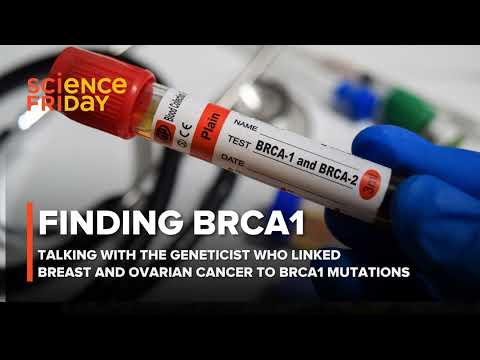
A trailblazing geneticist reflects on her life and work
Geneticist Mary-Claire King traces her journey from childhood math puzzles to groundbreaking discoveries, revealing how mentorship helped her persevere through PhD failures, how she proved humans and chimps share 99% of protein-coding DNA, and how the 1973 Chile coup redirected her toward cancer genetics.

THE KISSING BUG - Author Livestream and Q&A with Daisy Hernández #SciFriBookClub
Author Daisy Hernández discusses her investigation into Chagas disease—a parasitic illness more prevalent in the U.S. than Zika yet virtually unknown to Americans—revealing how systemic "epidemiological divides" actively determine who receives care and who is left to suffer from treatable diseases based on wealth, geography, and immigration status.