Stanford Online

Stanford Online

1 M subscribers

You can gain access to a world of education through Stanford Online, the Stanford School of Engineering’s portal for academic and professional education offered by schools and units throughout Stanford University. https://online.stanford.edu/ Our robust catalog of degree programs, credit-bearing education, professional certificate programs, and free and open content is developed by Stanford faculty, enabling you to expand your knowledge, advance your career, and enhance your life. Stanford Online is operated and managed by the Stanford Engineering Center for Global & Online Education (CGOE). CGOE expands access to Stanford teaching and research, working in collaboration with faculty in the School of Engineering and throughout Stanford University to design and deliver extensive global, online, and enterprise education to a global audience.

24 summaries available YouTube ← All channels
Videos Channels Newsletter
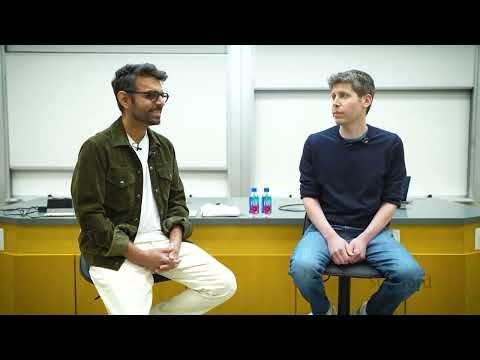
Stanford CS221 | Autumn 2025 | Lecture 20: Fireside Chat, Conclusion
58:49
Stanford Online Stanford Online

Stanford CS221 | Autumn 2025 | Lecture 20: Fireside Chat, Conclusion

Percy Liang reflects on AI's transformation from academic curiosity to global infrastructure, debunking sci-fi misconceptions about capabilities while arguing that academia's role in long-term research and critical evaluation remains essential as the job market shifts away from traditional entry-level software engineering.

16 days ago · 7 points
Stanford CS221 | Autumn 2025 | Lecture 19: AI Supply Chains
1:14:36
Stanford Online Stanford Online

Stanford CS221 | Autumn 2025 | Lecture 19: AI Supply Chains

This lecture examines AI's economic impact through the lens of supply chains and organizational strategy, demonstrating why understanding compute monopolies, labor market shifts, and corporate decision-making is as critical as tracking algorithmic capabilities.

16 days ago · 7 points
Stanford CS221 | Autumn 2025 | Lecture 18: AI & Society
1:12:10
Stanford Online Stanford Online

Stanford CS221 | Autumn 2025 | Lecture 18: AI & Society

This lecture argues that AI developers bear unique ethical responsibility for societal outcomes, framing AI as a dual-use technology that requires active steering toward beneficial applications while preventing misuse and accidental harms through rigorous auditing and an ecosystem-aware approach.

16 days ago · 8 points
Stanford CS221 | Autumn 2025 | Lecture 17: Language Models
1:19:46
Stanford Online Stanford Online

Stanford CS221 | Autumn 2025 | Lecture 17: Language Models

This lecture introduces modern language models as industrial-scale systems requiring millions of dollars and trillions of tokens to train, explaining their fundamental operation as auto-regressive next-token predictors that encode language structure through massive statistical modeling.

16 days ago · 10 points
Stanford CS221 | Autumn 2025 | Lecture 16: Logic II
1:15:47
Stanford Online Stanford Online

Stanford CS221 | Autumn 2025 | Lecture 16: Logic II

This lecture introduces First Order Logic as a powerful extension of propositional logic that uses objects, predicates, functions, and quantifiers to compactly represent complex relationships and generalizations without enumerating every possible instance.

16 days ago · 8 points
Stanford CS221 | Autumn 2025 | Lecture 15: Logic I
1:13:26
Stanford Online Stanford Online

Stanford CS221 | Autumn 2025 | Lecture 15: Logic I

This lecture introduces logic as a formal language for knowledge representation and reasoning, contrasting it with probabilistic methods and natural language. It establishes the foundational framework of syntax, semantics, and inference rules, then dives into propositional logic's mechanics including formulas, models, and interpretation functions.

16 days ago · 10 points
Stanford CS221 | Autumn 2025 | Lecture 13: Bayesian Networks and Gibbs Sampling
1:15:54
Stanford Online Stanford Online

Stanford CS221 | Autumn 2025 | Lecture 13: Bayesian Networks and Gibbs Sampling

This lecture explains how Bayesian networks compactly represent joint probability distributions through local conditional probabilities, then contrasts inefficient rejection sampling with Gibbs sampling—an MCMC method that iteratively modifies existing samples to satisfy evidence, enabling efficient approximate inference even with rare events.

16 days ago · 10 points
Stanford CS221 | Autumn 2025 | Lecture 12: Bayesian Networks I
1:17:36
Stanford Online Stanford Online

Stanford CS221 | Autumn 2025 | Lecture 12: Bayesian Networks I

This lecture transitions from model-free and model-based reinforcement learning to probabilistic reasoning, introducing Bayesian networks as a framework for representing uncertain world states. It establishes probability fundamentals—joint distributions, marginalization, and conditioning—using tensor operations (einops) to provide the mathematical foundation for efficient inference in complex domains.

16 days ago · 9 points
Stanford CS547 HCI Seminar | Winter 2026 | What's Up with AI?
1:03:13
Stanford Online Stanford Online

Stanford CS547 HCI Seminar | Winter 2026 | What's Up with AI?

Veteran AI researcher Terry Winograd argues that rather than focusing on apocalyptic futures or utopian promises, we should recognize AI as an accelerant of existing social problems—particularly in employment, resource allocation, and information integrity—that demand immediate societal attention.

22 days ago · 8 points