Stanford's Code in Place Info Session with Mehran Sahami
TL;DR
Stanford professors Mehran Sahami and Chris Peach present Code in Place, a free 6-week global Python program achieving 50-60% completion rates—over 10x higher than typical online courses—by pairing thousands of volunteer section leaders with small student cohorts for personalized, human-centric instruction.
🌍 Origins & Global Mission 3 insights
Pandemic-born educational initiative
Created in 2020 during COVID-19 to combat loneliness and education inequality by transforming 'shelter in place' into 'code in place,' offering accessible programming education during global lockdowns.
Massive worldwide scale
To date, the program has taught over 60,000 students from 150+ countries with the help of more than 5,500 volunteer section leaders, serving diverse demographics across all age groups.
Completely free access
The program removes financial barriers to elite computer science education, offering half to two-thirds of Stanford's introductory CS106A curriculum at no cost to students globally.
👥 The Section Leader Model 3 insights
Human connection drives completion
Small cohorts of approximately 10 students meet weekly with trained section leaders, achieving 50-60% completion rates compared to the 5% typical of traditional MOOCs through personalized accountability.
Teaching as learning
The program operates on the philosophy that human teaching potential is underutilized and that teaching reinforces learning, creating a joyful, reciprocal educational experience for volunteers.
Structured volunteer training
Section leaders receive comprehensive support including welcome meetings, two live practice sessions, and ongoing guidance before teaching their six weekly sections during the 6-week program.
💻 Curriculum & Learning Experience 3 insights
Industry-standard Python instruction
Students learn Python—the world's most popular programming language for AI and data science—through video lectures mirroring actual Stanford classes and a browser-based coding environment requiring no software installation.
Zero prerequisites required
The only requirements are basic computer literacy (using a mouse and web browser); the course assumes no prior programming knowledge and teaches coding from the ground up.
Multi-layered support system
Beyond weekly 50-minute live sections, students access online readings, worked programming examples, and vibrant discussion forums staffed by section leaders, head TAs, and professors.
Bottom Line
Join Code in Place either as a complete beginner seeking to learn Python through human connection rather than isolated video watching, or as a section leader to reinforce your own coding skills while helping others—either way, you'll participate in a scalable educational model that proves personalized teaching transforms online learning outcomes.
More from Stanford Online
View all
Stanford MS&E435 Economics of the AI Supercycle | Spring 2026 | Building AI Factories
Crusoe Energy CEO Chase Lockmiller explains how AI data centers represent history's second-largest infrastructure investment, driven by the economic potential of scalable 'digital labor.' He reveals Crusoe's strategy of building massive AI factories in stranded-power locations like Abilene, Texas, to overcome the industry's critical bottleneck: energized data center capacity.

AI in Healthcare Series: Inside the Rise of AI in Healthcare, Open Evidence and Cyber Risks
Former U.S. Chief Data Scientist DJ Patil warns that healthcare systems are dangerously unprepared for AI-enabled cyberattacks from nation states, while simultaneously seeing rapid democratization of medical knowledge through tools like Open Evidence that are fundamentally reshaping the doctor-patient relationship.
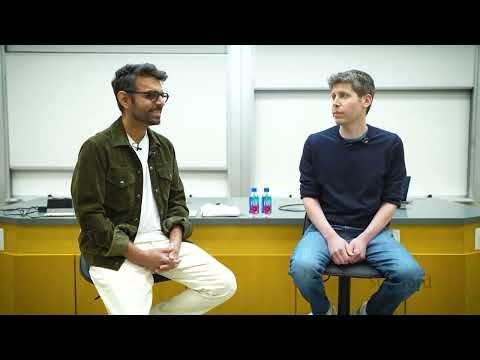
Stanford CS153 Frontier Systems | Scale, AGI, and the Future of Everything
Sam Altman explains how AI has fundamentally altered startup economics, enabling small teams to achieve unprecedented scale, while sharing OpenAI's journey from research lab to product company and arguing that pushing systems beyond conventional scaling limits often reveals emergent properties that consensus thinking misses.

Stanford CS547 HCI Seminar | Spring 2026 | The Modern Motivators of Play
The speaker challenges the game industry's outdated assumption that players primarily seek competition, presenting 2024 data showing only 18% of gamers are motivated by competition while 50% seek stress relief and 40% want community. They introduce a framework of nine motivators divided into classic (Fun, Mastery, Competition, Immersion, Meditation, Comfort) and modern (Self-expression, Companionship, Education), arguing that successful games must layer social and creative motivators onto traditional designs to serve contemporary player needs.