Stanford CS153 Frontier Systems | Nikhyl Singhal from Skip on Product Management in the AI Era
TL;DR
Nikhyl Singhal argues that product management is evolving from manual information gathering to AI-augmented strategic judgment, requiring PMs to focus on solving genuine customer problems while leveraging AI's ability to synthesize vast customer data streams.
📈 The Product Management Lifecycle 4 insights
Pre-Product-Market Fit Phase
Founders drive rapid experimentation without PMs to find resonance with customers, discarding ideas freely until smoke appears.
Post-Product-Market Fit Transition
PMs enter to introduce process and consistency, coordinating multiple teams to standardize the winning product rather than continuing chaotic experimentation.
Hypergrowth Expansion
Product leaders scale existing offerings while expanding into adjacent markets through large coordinated teams managed by CPOs.
Late-Stage Reinvention
Mature companies must rediscover zero-to-one innovation to combat innovator's dilemma despite the distraction of massive existing business lines.
⚠️ Lessons from Failed Products 3 insights
Solve Real Customer Problems
Google Hangouts failed because it solved the company's internal code fragmentation issue rather than any actual user desire for unified messaging apps.
Speed Beats Initial Polish
Google's most successful products launched with poor initial quality but won through rapid iteration cycles, such as Chrome shipping every six weeks versus Firefox's quarterly releases.
Corporate Impatience
Large incumbents abandon projects that don't show immediate success, whereas startups benefit from the ability to iterate and improve over time.
🤖 AI Transformation of Product Work 3 insights
Automated Signal Processing
AI agents now synthesize daily summaries of customer service interactions, sales calls, and user surveys that previously required manual PM research.
Intelligent Prioritization
Algorithms automatically rank feature requests by revenue impact, implementation complexity, and brand consistency, surfacing insights that forward-deployed engineers traditionally extracted.
Role Convergence
AI diminishes the distinction between forward-deployed engineers, designers, and PMs by automating customer insight extraction and enabling designers to vibe code.
Bottom Line
Success in modern product management requires shifting from data collection to high-judgment decision-making using AI-synthesized insights, while maintaining relentless iteration speed and solving real customer problems rather than internal company issues.
More from Stanford Online
View all
Stanford MS&E435 Economics of the AI Supercycle | Spring 2026 | Building AI Factories
Crusoe Energy CEO Chase Lockmiller explains how AI data centers represent history's second-largest infrastructure investment, driven by the economic potential of scalable 'digital labor.' He reveals Crusoe's strategy of building massive AI factories in stranded-power locations like Abilene, Texas, to overcome the industry's critical bottleneck: energized data center capacity.

AI in Healthcare Series: Inside the Rise of AI in Healthcare, Open Evidence and Cyber Risks
Former U.S. Chief Data Scientist DJ Patil warns that healthcare systems are dangerously unprepared for AI-enabled cyberattacks from nation states, while simultaneously seeing rapid democratization of medical knowledge through tools like Open Evidence that are fundamentally reshaping the doctor-patient relationship.
Stanford CS153 Frontier Systems | Scale, AGI, and the Future of Everything
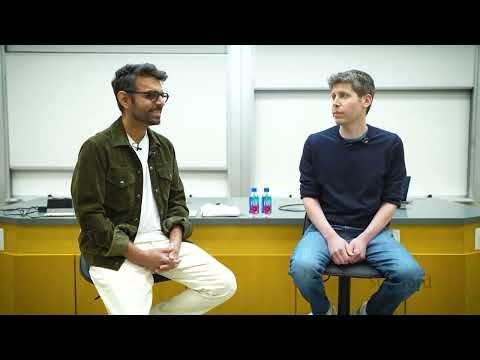
Sam Altman explains how AI has fundamentally altered startup economics, enabling small teams to achieve unprecedented scale, while sharing OpenAI's journey from research lab to product company and arguing that pushing systems beyond conventional scaling limits often reveals emergent properties that consensus thinking misses.

Stanford CS547 HCI Seminar | Spring 2026 | The Modern Motivators of Play
The speaker challenges the game industry's outdated assumption that players primarily seek competition, presenting 2024 data showing only 18% of gamers are motivated by competition while 50% seek stress relief and 40% want community. They introduce a framework of nine motivators divided into classic (Fun, Mastery, Competition, Immersion, Meditation, Comfort) and modern (Self-expression, Companionship, Education), arguing that successful games must layer social and creative motivators onto traditional designs to serve contemporary player needs.