Inside the New Media Team with Marc Andreessen & Ben Horowitz
TL;DR
Marc Andreessen and Ben Horowitz detail the shift from defensive, leak-fearing 'old media'—where narrow channels and corporate blandness reigned—to an offensive, infinite-channel 'new media' paradigm where flooding the zone with authentic, long-form content and embracing controversy as 'interesting' is the only viable strategy.
📺➡️🎙️ Old Media vs. New Media Strategy 3 insights
Defense vs. offense as core philosophy
Old media required defensive posture against leaks, where a single misinterpreted story in the NYT or WSJ could cause existential damage that was impossible to correct due to limited channels and permanent search results.
Flood the zone beats damage control
In new media, appearing on 30 podcasts with larger audiences than traditional outlets allows organizations to erase negative stories by overwhelming them with more interesting content rather than issuing corrections.
Scarcity forced synthetic messaging
Traditional media's narrow bandwidth—limited by column inches and broadcast airtime—forced companies to encode messages into minimal, least-offensive bits, creating an 80-year reign of 'plastic and boring' corporate communication.
🏢➡️👤 The Death of Corporate Abstraction 3 insights
CEOs used to say absolutely nothing
Old media training taught executives to deliberately make no news by saying nothing substantive on stage, treating the corporate brand as an abstracted entity separate from the humans making decisions.
Direct access destroys the funnel
Technology blew the narrow media funnel 'to smithereens,' making it possible and necessary for actual decision-makers to speak directly, explain their thinking, and show their personalities rather than hiding behind corporate trademarks.
Authenticity builds trust faster
When leaders speak in long-form about their actual assumptions and reasoning, it creates credibility that compressed, synthetic corporate messaging never achieved, making 'corporations are people' a literal operational reality.
🛡️📝 Long-Form Content as Protection 3 insights
Context prevents cancellation
Andreessen notes that every public blow-up he experienced came from short-form tweets taken out of context, whereas hour-long discussions or full essays provide explanatory armor that makes it harder to 'blow people up.'
Sound bites caused career deaths
Old media's 5-second clips led to thousands of careers ending over misinterpretations that couldn't be corrected due to lack of access to the audience; long-form allows complex systems thinking necessary for tech and politics.
The Joe Rogan CEO standard
Modern media training prioritizes being interesting enough to sustain a three-hour podcast conversation, inverting the old model where the ideal CEO deliberately avoided making any news whatsoever.
👑⚡ Leadership Selection and Power 2 insights
Founder advantage in new media
Founder CEOs possess original ideas which are inherently interesting, while professional CEOs are selected by boards for being uncontroversial and vanilla—precisely the qualities that fail in a media landscape rewarding authentic interestingness.
Controversy signals relevance
In new media, being powerful and interesting guarantees controversy and detractors, which serves as evidence of impact rather than a brand risk to be eliminated through corporate PR defense.
Bottom Line
Organizations must abandon defensive corporate messaging and fully commit to high-volume, long-form, personality-driven content that prioritizes being interesting over being inoffensive.
More from a16z Podcast
View all
Jake Paul on Going From YouTube to Boxing to Investing | a16z ft. Anti Fund
Jake Paul and Anti Fund co-founder Geoffrey Woo announce their oversubscribed $100 million growth fund backed by tier-one LPs like Andreessen Horowitz, while explaining how Paul's resilience and analytical operator mindset translate from entertainment to backing frontier tech companies.
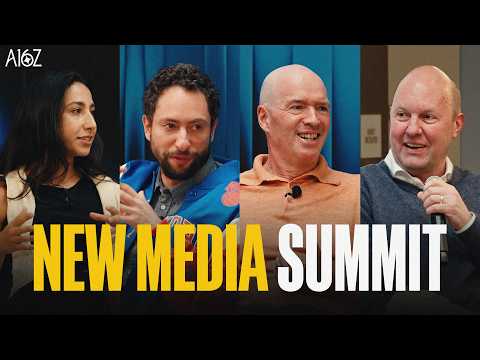
The Media Game Has Changed
The media landscape has shifted from defense-oriented legacy outlets demanding plastic, controversy-free performances to an offense-driven ecosystem where authenticity and founder-led personal brands dominate; success now requires treating public conversations like private ones and building direct channels rather than relying on traditional press.

Why AI Feels Like the Internet in 1997 | Benedict Evans on a16z
Benedict Evans compares today's AI landscape to the internet in 1997, arguing that agentic coding has emerged as the first true product-market fit use case while the industry grapples with severe infrastructure scarcity and an uncertain future where foundation models risk becoming commoditized infrastructure rather than value-capturing platforms.

The Rule for Picking AI Winners | The a16z Show
Frontier AI model companies are achieving hyperscaler-scale revenue growth with less than 5% economic diffusion, creating extraordinary value creation potential, yet rapid technological shifts and uncertain market structures make predicting ultimate winners increasingly difficult compared to prior tech cycles.