Stanford Robotics Seminar ENGR319 | Winter 2026 | Bringing AI Up To Speed
TL;DR
Despite AI solving complex closed systems like chess decades ago, autonomous driving remains unsolved due to the 'open world' problem of unbounded physical complexity. This creates fundamental gaps in physical reasoning and safety validation that current foundation models struggle to overcome, requiring new comparative metrics to measure real-world reliability.
🌍 The Open World Challenge 3 insights
Chess mastery versus driving failure
While AI surpassed human chess grandmasters years ago, self-driving cars still require human teleoperators and fail at mundane tasks because driving is an open system where "anything can happen" unlike chess's bounded rules.
The coverage complexity problem
Autonomous driving involves an impossibly vast hyperdimensional space spanning all possible objects, diverse environments (weather, culture, geometry), and temporal interactions that cannot be fully enumerated or trained.
Human generalization advantage
Humans effortlessly adapt to new vehicles and unfamiliar roads through generalized physical reasoning, while AVs freeze or fail in novel edge cases outside their Operational Design Domain.
⚛️ Physical Intelligence Limitations 3 insights
Hallucinations in physical reasoning
Current generative AI creates cinematically realistic videos but fails at background physics—showing cyclists passing through vehicles or pedestrians spawning mid-road—revealing lack of causal understanding.
Virtual versus embodied intelligence
Language and vision AI operate in virtual environments, but physical AI requires understanding cause-and-effect, contact dynamics, and embodiment through real-world experience.
Non-negotiable safety requirements
Unlike chatbots where hallucinations are harmless, autonomous vehicles require zero-error physical reasoning because mistakes cause severe real-world consequences.
📊 The Safety Measurement Crisis 3 insights
No consensus on safety metrics
The industry lacks a reliable measuring stick for AV safety because safety is contextual—what is safe in one environment may not transfer globally.
Comparative safety approaches
Researchers propose comparing systems via scenario embeddings rather than defining absolute safety, automatically mining datasets for comparable test cases without manual labeling.
Multi-modal scenario analysis
Recent work explores trajectory-space analysis and LLM-based reasoning to assess spati-temporal interactions, moving beyond pixel-level similarity to compare actual traffic behaviors.
Bottom Line
To advance autonomous driving, the field must shift from scaling virtual intelligence to developing rigorous physical reasoning capabilities and standardized comparative safety metrics that can validate AI performance across the unbounded complexity of real-world open systems.
More from Stanford Online
View all
Stanford MS&E435 Economics of the AI Supercycle | Spring 2026 | Applications, Coding AI
Vercel founder Guillermo Rauch explains how AI coding agents have expanded the software development market by 10-100x, driving a fundamental shift from traditional web services to 'agentic infrastructure' where tokens replace pixels as the primary commodity and deployment becomes the critical value creator.

Stanford MS&E435 Economics of the AI Supercycle | Spring 2026 | Building AI Factories
Crusoe Energy CEO Chase Lockmiller explains how AI data centers represent history's second-largest infrastructure investment, driven by the economic potential of scalable 'digital labor.' He reveals Crusoe's strategy of building massive AI factories in stranded-power locations like Abilene, Texas, to overcome the industry's critical bottleneck: energized data center capacity.

AI in Healthcare Series: Inside the Rise of AI in Healthcare, Open Evidence and Cyber Risks
Former U.S. Chief Data Scientist DJ Patil warns that healthcare systems are dangerously unprepared for AI-enabled cyberattacks from nation states, while simultaneously seeing rapid democratization of medical knowledge through tools like Open Evidence that are fundamentally reshaping the doctor-patient relationship.
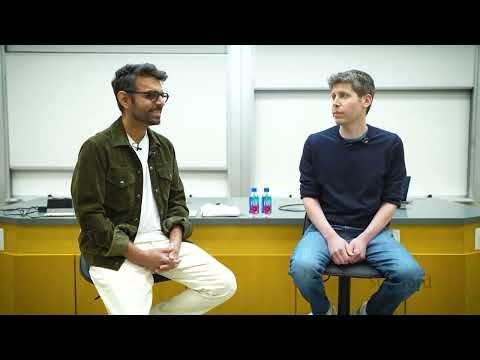
Stanford CS153 Frontier Systems | Scale, AGI, and the Future of Everything
Sam Altman explains how AI has fundamentally altered startup economics, enabling small teams to achieve unprecedented scale, while sharing OpenAI's journey from research lab to product company and arguing that pushing systems beyond conventional scaling limits often reveals emergent properties that consensus thinking misses.