Stanford Robotics Seminar ENGR319 | Spring 2026 | Integrated Learning and Planning
TL;DR
This seminar presents a neuro-symbolic approach to robot learning that combines neural visual representations with physics-based constraint optimization to enable one-shot skill acquisition, achieving over 90% success rates on novel objects compared to 0% for standard policy learning methods.
⚠️ The Data Efficiency Problem in Modern Robotics 3 insights
Current approaches require massive datasets
End-to-end policy learning systems like those from Physical Intelligence need hundreds of hours of teleoperation data just to learn simple tasks like folding boxes or basic actuator manipulation.
Pure policy learning lacks compositionality
Standard approaches cannot stitch together separate skills (like picking up tools) to solve novel multi-step tasks because they fail to account for how early actions constrain later ones.
Human-level generalization remains unmatched
Humans can learn complex manipulation tasks from a single demonstration and generalize to new objects, states, and goals instantly, while current robotic systems fail to transfer across categories.
🧠 Neuro-Symbolic Planning Framework 3 insights
World models plus planning over policies
The proposed paradigm treats physical intelligence as compositional world modeling—representing objects, properties, and actions abstractly—combined with search-based planning rather than direct policy execution.
Actions as constraint optimization
Instead of learning fixed policies, the system models actions as constraint satisfaction problems that combine rigid body physics, geometric constraints, and task-specific requirements, enabling temporal and spatial composition.
Two-level learning architecture
The framework learns which constraints are task-relevant from demonstrations, then uses physics simulators and motion planners to generate trajectories that satisfy those constraints without learning physics from scratch.
🎯 One-Shot Learning Results 3 insights
Visual correspondence with DINOv2
The system uses pretrained visual features to identify functional contact points on novel objects from a single demonstration, then verifies proposals through physics-based stability analysis and motion planning.
90% success on out-of-distribution objects
On a hanging task benchmark with completely unseen 3D-printed alphabetical shapes, the method achieved over 90% success compared to 0% for pure policy learning approaches and marginal gains for neural feature-only methods.
Cross-category generalization
The system generalizes from demonstrations on hangers to successfully manipulate mugs, kitchenware, and arbitrary geometric shapes without additional training data by reasoning about functional correspondence.
Bottom Line
Robotics should abandon data-heavy end-to-end policy learning in favor of neuro-symbolic systems that combine neural perception with physics-based constraint optimization, enabling robots to learn complex skills from single demonstrations and reliably generalize to novel objects.
More from Stanford Online
View all
Stanford MS&E435 Economics of the AI Supercycle | Spring 2026 | Applications, Coding AI
Vercel founder Guillermo Rauch explains how AI coding agents have expanded the software development market by 10-100x, driving a fundamental shift from traditional web services to 'agentic infrastructure' where tokens replace pixels as the primary commodity and deployment becomes the critical value creator.

Stanford MS&E435 Economics of the AI Supercycle | Spring 2026 | Building AI Factories
Crusoe Energy CEO Chase Lockmiller explains how AI data centers represent history's second-largest infrastructure investment, driven by the economic potential of scalable 'digital labor.' He reveals Crusoe's strategy of building massive AI factories in stranded-power locations like Abilene, Texas, to overcome the industry's critical bottleneck: energized data center capacity.

AI in Healthcare Series: Inside the Rise of AI in Healthcare, Open Evidence and Cyber Risks
Former U.S. Chief Data Scientist DJ Patil warns that healthcare systems are dangerously unprepared for AI-enabled cyberattacks from nation states, while simultaneously seeing rapid democratization of medical knowledge through tools like Open Evidence that are fundamentally reshaping the doctor-patient relationship.
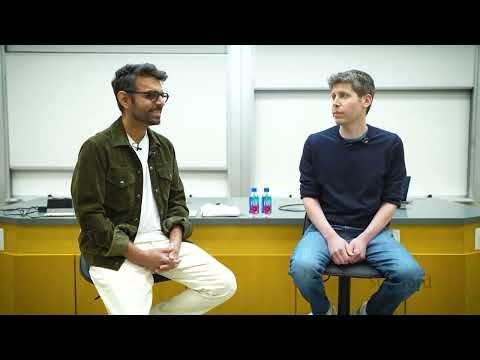
Stanford CS153 Frontier Systems | Scale, AGI, and the Future of Everything
Sam Altman explains how AI has fundamentally altered startup economics, enabling small teams to achieve unprecedented scale, while sharing OpenAI's journey from research lab to product company and arguing that pushing systems beyond conventional scaling limits often reveals emergent properties that consensus thinking misses.