Stanford CS153 Frontier Systems | The AI Native Company: How One Founder Becomes a 1000x Engineer
TL;DR
YC's Garry Tan and Diana Hu explain how AI coding agents are creating '1000x engineers' and enabling tiny teams to generate tens of millions in revenue within months rather than years. They detail the shift from AI copilots to autonomous software factories requiring rigorous testing frameworks and strategic prompting skills to achieve production-grade output at unprecedented scale.
🚀 Capital & Growth Velocity 2 insights
Revenue acceleration from years to months
AI-native companies now achieve tens of millions in annual revenue within 12 months, a milestone that previously required 4-5 years and Series B-level capital to reach.
Capital efficiency of small teams
Six-person teams can generate $10 million in revenue using AI workflows, eliminating the historical need for massive headcount and millions in early-stage funding.
⚡ The 1000x Engineer 3 insights
Million-line codebases built solo
Garry Tan wrote approximately one million lines of code using Claude Code after not coding since December, accumulating over 100,000 GitHub stars and 15,000 daily active users.
Testing prevents AI slop
Production-quality output requires achieving 80-90% test coverage through 'plan-eng-review' cycles to control hallucinations and ensure code is actually usable.
Productivity multiples vs. history
Engineers using modern AI agents are approximately 1000x more productive than Googlers in 2005, marking a shift from autocomplete copilots to autonomous software factories.
🏭 AI-Native Architecture 3 insights
Human-agent symbiosis
Future companies combine human judgment with AI agents possessing memory, evaluation capabilities, and tight customer feedback loops rather than treating AI as mere tooling.
Distilled expertise as code
Effective workflows use 'skills' like the YC Office Hour persona, which distills thousands of partner conversations into strategic prompting frameworks that enforce rigorous problem-solving.
Strategic prompting for 10x outcomes
The 'plan CEO review' skill forces systems to define the platonic ideal and 10x version of features, ensuring tactical coding aligns with strategic roadmaps rather than incremental improvements.
🌊 Redefining Scope and Ambition 2 insights
Permission to boil the ocean
Individual founders can now accomplish work previously requiring 500-1000 engineers, rendering traditional constraints on project scope and team size obsolete.
Misaligned time expectations
AI models consistently underestimate task duration by orders of magnitude (predicting weeks for work completed in hours), revealing that societal expectations about engineering output remain calibrated to pre-AI limitations.
Bottom Line
Stop using AI as autocomplete; implement rigorous testing frameworks and strategic prompting skills to operate a software factory capable of 1000x output.
More from Stanford Online
View all
Stanford MS&E435 Economics of the AI Supercycle | Spring 2026 | Applications, Coding AI
Vercel founder Guillermo Rauch explains how AI coding agents have expanded the software development market by 10-100x, driving a fundamental shift from traditional web services to 'agentic infrastructure' where tokens replace pixels as the primary commodity and deployment becomes the critical value creator.

Stanford MS&E435 Economics of the AI Supercycle | Spring 2026 | Building AI Factories
Crusoe Energy CEO Chase Lockmiller explains how AI data centers represent history's second-largest infrastructure investment, driven by the economic potential of scalable 'digital labor.' He reveals Crusoe's strategy of building massive AI factories in stranded-power locations like Abilene, Texas, to overcome the industry's critical bottleneck: energized data center capacity.

AI in Healthcare Series: Inside the Rise of AI in Healthcare, Open Evidence and Cyber Risks
Former U.S. Chief Data Scientist DJ Patil warns that healthcare systems are dangerously unprepared for AI-enabled cyberattacks from nation states, while simultaneously seeing rapid democratization of medical knowledge through tools like Open Evidence that are fundamentally reshaping the doctor-patient relationship.
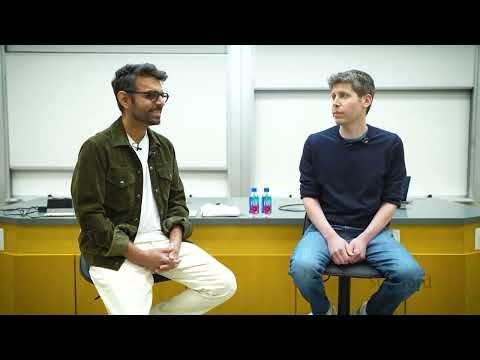
Stanford CS153 Frontier Systems | Scale, AGI, and the Future of Everything
Sam Altman explains how AI has fundamentally altered startup economics, enabling small teams to achieve unprecedented scale, while sharing OpenAI's journey from research lab to product company and arguing that pushing systems beyond conventional scaling limits often reveals emergent properties that consensus thinking misses.