Stanford MS&E435 Economics of the AI Supercycle | Spring 2026 | Enterprise Internal Knowledge
TL;DR
Former OpenAI researcher Yash Bottle traces AI model evolution from AlexNet to reasoning agents, identifying continual learning as the next bottleneck while explaining why code dominance stems from verifiable rewards and why enterprises must leverage proprietary data to bridge the gap between frontier models and business context.
🧠 Evolution of Model Training 3 insights
AlexNet ended handcrafted feature engineering
The 2012 breakthrough proved that scaling compute and data with deep learning produces superior predictive accuracy, replacing manual edge-detection and feature extraction with learned representations.
Transformers unlocked language model scaling
The self-attention architecture enabled massively parallel training on GPUs and processing of long sequences, moving beyond recurrent neural networks to make large-scale language modeling feasible.
Reasoning models introduced test-time compute scaling
O1 and similar models demonstrated that chain-of-thought reasoning emerges as a property when models are trained in constrained RL environments with increased inference-time computation, not through explicit programming.
⚡ Bottlenecks and Future Challenges 2 insights
Historical constraints shifted from hardware to data efficiency
Bottlenecks evolved from compute availability to architecture design, then to pre-training data scale, and currently to creating effective RL environments for post-training refinement.
Continual learning is the next frontier
Future breakthroughs require models to learn from extremely sparse rewards—like humans learning not to touch a hot stove after one interaction—rather than requiring internet-scale data for every new concept.
💻 Why Code Dominates AI Training 3 insights
Verifiable rewards enable deterministic training
Code provides clear feedback loops through compilation and unit tests, allowing reinforcement learning with verifiable rewards unlike subjective tasks where correctness is ambiguous.
Code serves as an AGI-complete interface
Researchers view coding ability as universal because any task can be decomposed into code, which is why modern agents use programming as a general language to interact with the world rather than task-specific tool calls.
Synthetic data scales infinitely
Unlike other domains, code allows massive synthetic data generation and benefits from abundant prior data on the internet, making it the most data-efficient domain for training.
🏢 Enterprise AI and Internal Knowledge 2 insights
Frontier models lack business context
Current models act as 'smart geniuses that know nothing about your business,' while enterprises possess massive repositories of proprietary data that remain untapped by general-purpose AI.
Specialized models require enterprise data integration
Applied Compute addresses this gap by helping companies apply frontier training techniques to their internal knowledge bases, creating specialized models that combine reasoning capabilities with domain-specific intelligence.
Bottom Line
Organizations should immediately begin structuring and capturing their proprietary internal knowledge, as the competitive advantage in AI is shifting from using general frontier models to training specialized systems on domain-specific data.
More from Stanford Online
View all
Stanford MS&E435 Economics of the AI Supercycle | Spring 2026 | Applications, Coding AI
Vercel founder Guillermo Rauch explains how AI coding agents have expanded the software development market by 10-100x, driving a fundamental shift from traditional web services to 'agentic infrastructure' where tokens replace pixels as the primary commodity and deployment becomes the critical value creator.

Stanford MS&E435 Economics of the AI Supercycle | Spring 2026 | Building AI Factories
Crusoe Energy CEO Chase Lockmiller explains how AI data centers represent history's second-largest infrastructure investment, driven by the economic potential of scalable 'digital labor.' He reveals Crusoe's strategy of building massive AI factories in stranded-power locations like Abilene, Texas, to overcome the industry's critical bottleneck: energized data center capacity.

AI in Healthcare Series: Inside the Rise of AI in Healthcare, Open Evidence and Cyber Risks
Former U.S. Chief Data Scientist DJ Patil warns that healthcare systems are dangerously unprepared for AI-enabled cyberattacks from nation states, while simultaneously seeing rapid democratization of medical knowledge through tools like Open Evidence that are fundamentally reshaping the doctor-patient relationship.
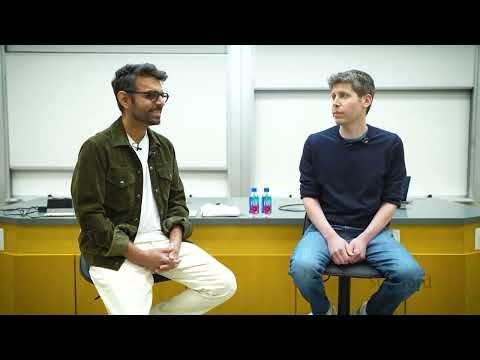
Stanford CS153 Frontier Systems | Scale, AGI, and the Future of Everything
Sam Altman explains how AI has fundamentally altered startup economics, enabling small teams to achieve unprecedented scale, while sharing OpenAI's journey from research lab to product company and arguing that pushing systems beyond conventional scaling limits often reveals emergent properties that consensus thinking misses.