Stanford CS547 HCI Seminar | Winter 2026 | Does GenAI Work in Education?
TL;DR
This seminar argues that GenAI's effectiveness in education hinges on 'knowledge engineering'—the systematic mapping of expert cognitive processes—to ensure high-fidelity, personalized feedback. A randomized trial demonstrates that TAs using AI suggestions based on detailed reasoning rubrics produced significantly better student learning outcomes than human-only feedback.
📊 The Mixed Reality of GenAI in Education 2 insights
Widespread adoption meets uncertain outcomes
While 70-85% of college students use GenAI for homework and hundreds of EdTech startups have emerged, studies show AI use can reduce learning retention when removed and decrease brain activity during writing tasks.
Variable quality in AI tutoring
Research indicates 30-50% of AI-generated tutoring hints contain quality issues, though carefully designed systems have outperformed active learning in college physics and improved K-12 math tutoring when providing real-time suggestions.
🧠 Knowledge Engineering & Cognitive Fidelity 2 insights
Solving Bloom's Two Sigma Challenge
Cognitive tutors from the 1990s achieved two standard deviation gains over conventional instruction by encoding expert production rules, demonstrating that AI must model human reasoning processes rather than just generate answers.
Granular decomposition enables precision
Breaking skills into specific steps and anticipating precise misconceptions—such as distinguishing between common and least common denominators—allows AI to provide targeted feedback and deliberate practice instead of generic hints.
📝 Case Study: Feedback Writer Trial 2 insights
Significant improvement in writing quality
In a randomized trial of 360 Econ 101 students, AI-mediated feedback produced revised essays with an effect size of 0.5, equivalent to moving a student from the 50th to 70th percentile compared to human-only feedback.
High-fidelity rubrics drive success
The system used checklists representing expert reasoning steps—such as identifying specific decision-makers harmed by externalities—to generate concrete hints without revealing answers, with AI judges assessing quality at 85% expert accuracy.
Bottom Line
To make GenAI work in education, developers must engineer detailed cognitive models that externalize expert reasoning into high-fidelity rubrics, enabling targeted feedback on learning processes rather than just evaluating final outputs.
More from Stanford Online
View all
Stanford MS&E435 Economics of the AI Supercycle | Spring 2026 | Applications, Coding AI
Vercel founder Guillermo Rauch explains how AI coding agents have expanded the software development market by 10-100x, driving a fundamental shift from traditional web services to 'agentic infrastructure' where tokens replace pixels as the primary commodity and deployment becomes the critical value creator.

Stanford MS&E435 Economics of the AI Supercycle | Spring 2026 | Building AI Factories
Crusoe Energy CEO Chase Lockmiller explains how AI data centers represent history's second-largest infrastructure investment, driven by the economic potential of scalable 'digital labor.' He reveals Crusoe's strategy of building massive AI factories in stranded-power locations like Abilene, Texas, to overcome the industry's critical bottleneck: energized data center capacity.

AI in Healthcare Series: Inside the Rise of AI in Healthcare, Open Evidence and Cyber Risks
Former U.S. Chief Data Scientist DJ Patil warns that healthcare systems are dangerously unprepared for AI-enabled cyberattacks from nation states, while simultaneously seeing rapid democratization of medical knowledge through tools like Open Evidence that are fundamentally reshaping the doctor-patient relationship.
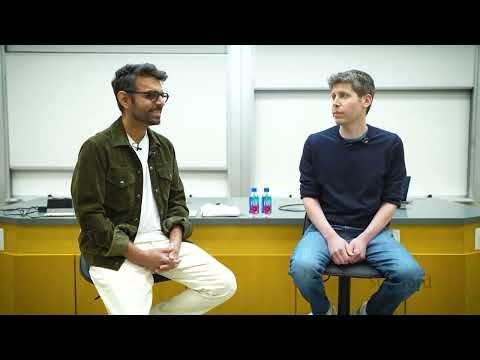
Stanford CS153 Frontier Systems | Scale, AGI, and the Future of Everything
Sam Altman explains how AI has fundamentally altered startup economics, enabling small teams to achieve unprecedented scale, while sharing OpenAI's journey from research lab to product company and arguing that pushing systems beyond conventional scaling limits often reveals emergent properties that consensus thinking misses.