Stanford CS221 | Autumn 2025 | Lecture 18: AI & Society
TL;DR
This lecture argues that AI developers bear unique ethical responsibility for societal outcomes, framing AI as a dual-use technology that requires active steering toward beneficial applications while preventing misuse and accidental harms through rigorous auditing and an ecosystem-aware approach.
⚖️ Technologist Responsibility & Dual-Use Nature 3 insights
Developers control design choices shaping society
Technologists possess unique power to determine AI's societal impact through decisions on model weights release, language support, and content moderation that no other stakeholder can make.
Historical analogy rejects ethical abdication
The lecture invokes the Wernher von Braun parable to argue that developers cannot ignore downstream consequences of their technology, as ethical responsibility cannot be outsourced once systems are deployed.
AI is inherently dual-use technology
Like nuclear energy, encryption, and rockets, AI can accelerate drug discovery or enable cyberattacks, requiring proactive steering toward benefits rather than passive acceptance of potential harm.
🎯 Intent-Impact Framework & Risk Categories 3 insights
Four quadrants classify societal outcomes
The intent-impact matrix distinguishes beneficial applications (good intent/positive impact), misuse (bad intent/negative impact), and accidents (good intent/negative impact) as the most common and preventable category.
Beneficial applications span critical sectors
Positive implementations include AlphaFold for protein structure prediction, personalized education systems, climate forecasting models, and assistive robotics for aging populations.
Misuse and accidents require different safeguards
While misuse includes cyberattacks and disinformation that demand defensive safeguards, accidents like algorithmic bias, sycophancy reinforcing false beliefs, and user overreliance require preventative testing and careful deployment.
🌍 Ecosystem Accountability & Auditing 2 insights
Upstream and downstream impacts extend beyond models
The AI ecosystem encompasses upstream data labor, privacy risks, copyright concerns, and environmental resource extraction, alongside downstream effects including job displacement and toxic content generation.
Third-party auditing exposes hidden inequality
The 2018 Gender Shades study revealed that facial recognition systems had significantly higher error rates for darker-skinned women, demonstrating how independent auditing can expose intersectional bias and incentivize technical corrections.
Bottom Line
AI developers must adopt an ecosystem view that prioritizes preventative testing for accidental harms like bias and overreliance, while implementing safeguards against misuse, recognizing that design choices made during development irrevocably shape societal outcomes.
More from Stanford Online
View all
Stanford MS&E435 Economics of the AI Supercycle | Spring 2026 | Applications, Coding AI
Vercel founder Guillermo Rauch explains how AI coding agents have expanded the software development market by 10-100x, driving a fundamental shift from traditional web services to 'agentic infrastructure' where tokens replace pixels as the primary commodity and deployment becomes the critical value creator.

Stanford MS&E435 Economics of the AI Supercycle | Spring 2026 | Building AI Factories
Crusoe Energy CEO Chase Lockmiller explains how AI data centers represent history's second-largest infrastructure investment, driven by the economic potential of scalable 'digital labor.' He reveals Crusoe's strategy of building massive AI factories in stranded-power locations like Abilene, Texas, to overcome the industry's critical bottleneck: energized data center capacity.

AI in Healthcare Series: Inside the Rise of AI in Healthcare, Open Evidence and Cyber Risks
Former U.S. Chief Data Scientist DJ Patil warns that healthcare systems are dangerously unprepared for AI-enabled cyberattacks from nation states, while simultaneously seeing rapid democratization of medical knowledge through tools like Open Evidence that are fundamentally reshaping the doctor-patient relationship.
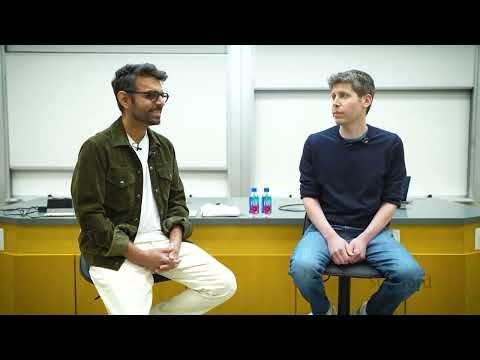
Stanford CS153 Frontier Systems | Scale, AGI, and the Future of Everything
Sam Altman explains how AI has fundamentally altered startup economics, enabling small teams to achieve unprecedented scale, while sharing OpenAI's journey from research lab to product company and arguing that pushing systems beyond conventional scaling limits often reveals emergent properties that consensus thinking misses.