Stanford CS153 Frontier Systems | Ben Horowitz from a16z on Venture Capital Systems, Network Effects
TL;DR
Ben Horowitz explains how Andreessen Horowitz rearchitected venture capital by treating entrepreneurs as customers, centralizing control to enable scaling, and bootstrapping network effects through asymmetric early investments.
🏗️ Redesigning Venture Capital Structure 3 insights
Treat entrepreneurs as product customers
Shifted the VC model from pure investment vehicle to comprehensive service product, solving the historically poor founder experience beyond capital injection.
Centralize control to enable organizational scale
Abandoned the traditional partnership consensus model to allow rapid reorganization and expansion into new sectors like crypto and bio without political gridlock.
Optimize for high-fidelity conversations
Structured teams into small groups of approximately seven people maximum to maintain truth-seeking dialogue rather than presentation culture.
📈 Market Expansion & Contrarian Bets 3 insights
Bet on software eating the world
Rejected industry consensus that only 15 companies yearly could reach $100M revenue, forecasting 200+ technology companies as traditional industries digitized.
The Skype 'insanity' investment
Allocated roughly $75 million (one quarter of the first $300M fund) to the Skype buyout by understanding the founders' emotional attachment to the brand trumped IP ownership risks that scared other investors.
Prove thesis through performance
Realigned skeptical institutional LPs by delivering returns first, letting success validate updated market assumptions rather than debating theory.
🌐 Network Effects & Bootstrapping 3 insights
Architect firm as n-squared network
Built the firm as a relationship network connecting engineers, executives, and corporate buyers, creating exponential value as each additional node strengthened the whole.
Bootstrap through asymmetric capital sacrifice
Founded the firm by taking zero salaries and reinvesting all management fees into network infrastructure, including leveraging HP Enterprise Briefing Center contacts to access Fortune 500 decision-makers.
Survive incumbent immune responses
Endured dismissals from established VCs who labeled relationship-building tactics as 'just marketing' while systematically capturing asymmetric access that incumbents failed to replicate.
Bottom Line
To disrupt an established industry, redesign the fundamental system architecture by centralizing control for agility, reinvesting all early capital into network bootstrapping, and treating founders as customers rather than commodities.
More from Stanford Online
View all
Stanford MS&E435 Economics of the AI Supercycle | Spring 2026 | Applications, Coding AI
Vercel founder Guillermo Rauch explains how AI coding agents have expanded the software development market by 10-100x, driving a fundamental shift from traditional web services to 'agentic infrastructure' where tokens replace pixels as the primary commodity and deployment becomes the critical value creator.

Stanford MS&E435 Economics of the AI Supercycle | Spring 2026 | Building AI Factories
Crusoe Energy CEO Chase Lockmiller explains how AI data centers represent history's second-largest infrastructure investment, driven by the economic potential of scalable 'digital labor.' He reveals Crusoe's strategy of building massive AI factories in stranded-power locations like Abilene, Texas, to overcome the industry's critical bottleneck: energized data center capacity.

AI in Healthcare Series: Inside the Rise of AI in Healthcare, Open Evidence and Cyber Risks
Former U.S. Chief Data Scientist DJ Patil warns that healthcare systems are dangerously unprepared for AI-enabled cyberattacks from nation states, while simultaneously seeing rapid democratization of medical knowledge through tools like Open Evidence that are fundamentally reshaping the doctor-patient relationship.
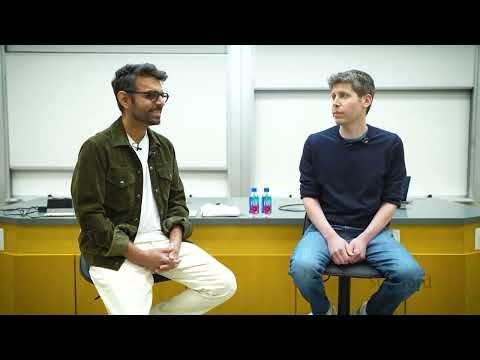
Stanford CS153 Frontier Systems | Scale, AGI, and the Future of Everything
Sam Altman explains how AI has fundamentally altered startup economics, enabling small teams to achieve unprecedented scale, while sharing OpenAI's journey from research lab to product company and arguing that pushing systems beyond conventional scaling limits often reveals emergent properties that consensus thinking misses.