Stanford CS25: Transformers United V6 I From Next-Token Prediction to Next-Generation Intelligence
TL;DR
Shrimai Prabhumoye presents advanced LLM pre-training strategies from her work at Nvidia, demonstrating that curriculum learning (two-phase training) and front-loading reasoning data during pre-training create stronger foundations and durable performance gains that cannot be matched by increased compute in later stages.
🗂️ Data Curation & Curriculum Learning 2 insights
Two-phase pre-training maximizes data potential
A curriculum approach where phase one emphasizes diverse, lower-quality web data and phase two focuses on high-quality sources (math, code, Wikipedia) with repeated epochs yields 17% better performance than naive training and 3.4% better than optimal blending without ordering.
Quality and epoch estimation prevent diminishing returns
Building quality classifiers and estimating optimal repetition rates for each data source before creating blends ensures high-value tokens are fully utilized without overfitting, addressing projections that LLMs will exhaust 95% of human-generated data by 2030.
🧠 Front-Loading Reasoning 3 insights
Reasoning should be a foundation, not a post-hoc addition
Injecting reasoning data during pre-training creates a 'reason base' model, unlike the standard pipeline that treats reasoning as a post-training fix; this approach yields 16% better performance immediately after pre-training and 9.3% better after SFT.
High-quality pre-training data unlocks hidden post-training gains
While mixing high-quality (SHQ) and low-quality (LDQ) reasoning data showed no benefit immediately after pre-training, models with both achieved a 4.25% boost after SFT, indicating early exposure to quality reasoning primes the model for better refinement later.
Early reasoning advantages are durable and compute-efficient
Models trained with reasoning data during pre-training maintained a 19% average advantage (39% on complex math benchmarks like AIME) after full post-training, and could not be matched by doubling SFT compute or reallocating all reasoning data to post-training.
Bottom Line
To build state-of-the-art reasoning models, allocate high-quality reasoning data to pre-training rather than reserving it solely for fine-tuning, and implement a two-phase curriculum that prioritizes data diversity before intensive high-quality repetition.
More from Stanford Online
View all
Stanford MS&E435 Economics of the AI Supercycle | Spring 2026 | Applications, Coding AI
Vercel founder Guillermo Rauch explains how AI coding agents have expanded the software development market by 10-100x, driving a fundamental shift from traditional web services to 'agentic infrastructure' where tokens replace pixels as the primary commodity and deployment becomes the critical value creator.

Stanford MS&E435 Economics of the AI Supercycle | Spring 2026 | Building AI Factories
Crusoe Energy CEO Chase Lockmiller explains how AI data centers represent history's second-largest infrastructure investment, driven by the economic potential of scalable 'digital labor.' He reveals Crusoe's strategy of building massive AI factories in stranded-power locations like Abilene, Texas, to overcome the industry's critical bottleneck: energized data center capacity.

AI in Healthcare Series: Inside the Rise of AI in Healthcare, Open Evidence and Cyber Risks
Former U.S. Chief Data Scientist DJ Patil warns that healthcare systems are dangerously unprepared for AI-enabled cyberattacks from nation states, while simultaneously seeing rapid democratization of medical knowledge through tools like Open Evidence that are fundamentally reshaping the doctor-patient relationship.
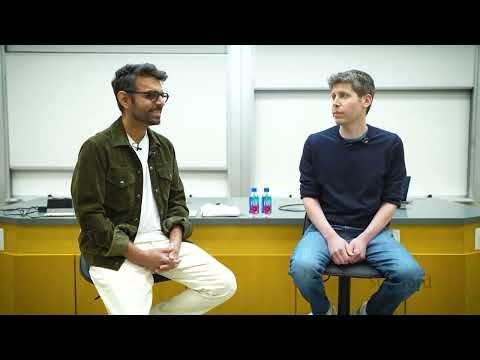
Stanford CS153 Frontier Systems | Scale, AGI, and the Future of Everything
Sam Altman explains how AI has fundamentally altered startup economics, enabling small teams to achieve unprecedented scale, while sharing OpenAI's journey from research lab to product company and arguing that pushing systems beyond conventional scaling limits often reveals emergent properties that consensus thinking misses.