Watch: Trump's Full Response to Supreme Court’s Tariff Decision | WSJ
TL;DR
President Trump sharply criticized the Supreme Court's decision blocking his use of the International Emergency Economic Powers Act (AIPA) to impose tariffs, while paradoxically claiming the ruling confirms broader presidential authority under alternative trade statutes, and announced immediate implementation of a 10% global tariff under Section 122 authority.
⚖️ Supreme Court Decision and Legal Response 3 insights
Trump condemns AIPA tariff ruling as 'deeply disappointing'
He expressed shame toward certain justices while praising Thomas, Alito, and Kavanaugh for their dissent, claiming foreign countries were "dancing in the streets" over the decision.
Ruling confirms broader embargo powers but blocks fees
He noted the paradox that while he cannot charge even $1 under AIPA, the decision affirms his right to impose embargoes, block trade, or license imports without fees.
Alternative statutes provide stronger tariff authority
He cited Justice Kavanaugh's dissent noting that other laws like the Trade Expansion Act of 1962 and Trade Act of 1974 still authorize tariffs and might justify even higher duties than previously imposed.
📋 Immediate Tariff Actions 3 insights
New 10% global tariff imposed under Section 122
Effective immediately, Trump announced a 10% universal tariff under Section 122 of the Trade Act of 1974, applied atop existing duties.
Existing national security tariffs remain in force
All current Section 232 national security tariffs and Section 301 duties remain fully in place and unaffected by the ruling.
New investigations launched under Section 301
The administration is initiating multiple Section 301 investigations to address unfair trading practices by other countries.
📈 Economic and National Security Claims 3 insights
Stock market records cited as proof of tariff success
Trump cited the Dow reaching 50,000 and S&P 500 hitting 7,000 as proof that tariffs drove economic success contrary to predictions of Nobel Prize-winning economists.
Steel industry revival attributed to trade protection
He shared an anecdote about a Georgia steel plant resuming double shifts and hiring sprees after tariffs stopped "foreign junk" from entering the market.
Tariffs credited with reducing fentanyl and ending wars
He claimed tariffs reduced fentanyl imports by 30% and helped settle eight conflicts including India-Pakistan tensions, with the Pakistani Prime Minister allegedly crediting him with saving 35 million lives.
Bottom Line
Despite the Supreme Court limiting AIPA tariff authority, Trump will immediately impose a 10% global tariff under Section 122 while maintaining existing tariffs, asserting that alternative trade statutes provide even stronger leverage than the blocked approach.
More from Wall Street Journal
View all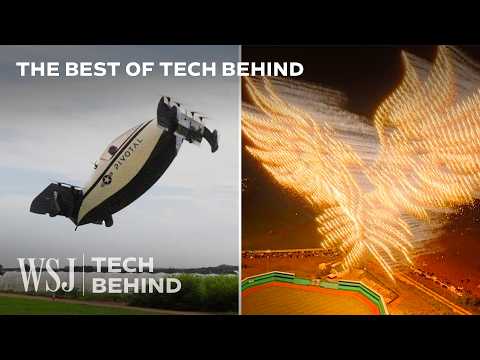
How IMAX, Flying Cars, Pyro Drone Shows and More Work | WSJ Tech Behind
From immersive sports domes using custom 8K optics to single-seat electric aircraft and transformable stadiums, advanced engineering is creating new categories of premium experiences that blur the line between physical and digital attendance while maximizing infrastructure utilization.

Breaking Down Iran’s Shahed Drones, China’s Invasion Barge and More | WSJ Equipped
The video analyzes three transformative military technologies: Lockheed Martin's F-35 collaborative combat aircraft integration, Blue Halo's cost-effective laser counter-drone systems, and China's new amphibious invasion barges designed to enable port-free assaults.

Watch Live: Hegseth Holds Press Conference at Central Command Headquarters | WSJ
Secretary of Defense Pete Hegseth and CENTCOM Commander Admiral Brad Cooper detailed significant U.S. military gains against Iran during Operation Epic Fury, emphasizing sustained air and naval dominance, the destruction of over 30 Iranian vessels, and a 90% reduction in enemy missile attacks while reaffirming unwavering commitment to complete mission objectives.

I Trained With U.S. Green Berets Prepping for War With Russia | WSJ
As NATO pivots from counter-terrorism to Arctic defense, US Green Berets undergo brutal cold-weather training in Scandinavia to prepare for potential conflict with Russia, revealing that survival itself—not combat—is the primary challenge in extreme subzero warfare.