Explore

Browse expert video summaries, filter by category, or search for topics.

Videos Channels Newsletter

Long-form interviews and conversations with tech, AI, and finance leaders (30min+)

Why Pursuing Happiness Makes You … Less Happy | Emily Esfahani Smith | TED
37:21
TED TED

Why Pursuing Happiness Makes You … Less Happy | Emily Esfahani Smith | TED

Emily Esfahani Smith explains that directly pursuing happiness often leads to dissatisfaction, while cultivating meaning through values and connection creates lasting resilience. She outlines how reframing goals around underlying values and prioritizing authentic belonging can help navigate life's inevitable transitions and suffering.

about 2 months ago · 8 points
Inside Clay's Sales Playbook | Becca Lindquist
1:14:23
20VC with Harry Stebbings 20VC with Harry Stebbings

Inside Clay's Sales Playbook | Becca Lindquist

Becca Lindquist, Head of Sales at Clay, shares her playbook for building high-performance sales teams, emphasizing that learning agility ('high slope') matters more than tenure or domain expertise, and that compensation structures should heavily reward overperformance rather than penalize misses.

about 2 months ago · 10 points
Why All-Time High Stocks Are Bullish for Bitcoin
52:45
The Pomp Podcast The Pomp Podcast

Why All-Time High Stocks Are Bullish for Bitcoin

Jordi Visser argues that AI infrastructure—specifically semiconductors, power generation, and memory—is driving historic stock market highs through genuine supply shortages rather than bubble speculation, while Bitcoin sits poised to rally as retail capital eventually rotates back from the AI trade.

about 2 months ago · 10 points
Stanford Leadership Forum 2026: Conversation with Ken Griffin
59:53
My First Million My First Million

Stanford Leadership Forum 2026: Conversation with Ken Griffin

A Stanford panel argues financial literacy is an economic imperative generating $400 billion in lifetime value for U.S. graduates, with experts advocating for guaranteed high school courses to prevent $5 billion weekly productivity losses and protect young investors from risky social media trends during the $83 trillion wealth transfer.

2 months ago · 10 points
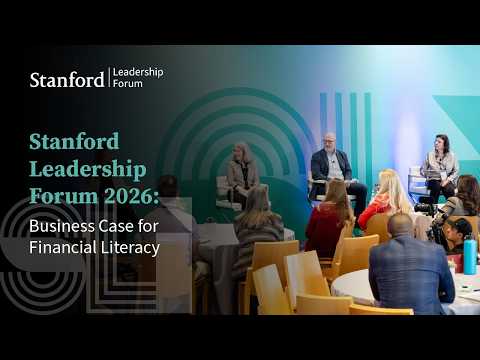
Stanford Leadership Forum 2026: Business Case for Financial Literacy
59:53
My First Million My First Million

Stanford Leadership Forum 2026: Business Case for Financial Literacy

Financial literacy delivers an estimated $400 billion in lifetime economic benefits to U.S. students while reducing workplace productivity losses, yet experts warn that without mandatory high school courses and safeguards against social media misinformation, young investors remain vulnerable to fraud and risky behaviors as capital markets democratize.

2 months ago · 10 points
Stanford Leadership Forum 2026: Business Taxation and Society
56:21
My First Million My First Million

Stanford Leadership Forum 2026: Business Taxation and Society

Leading tax experts warn that the U.S. faces an unsustainable fiscal crisis with debt-to-GDP projected to reach 183-233%, requiring urgent structural reforms to revenue and spending, while businesses navigate a new era of global tax transparency and unpredictable domestic policy tools including minimum taxes and tariffs.

2 months ago · 10 points
Stanford Leadership Forum 2026: Business Leaders as California’s Growth Drivers
36:30
My First Million My First Million

Stanford Leadership Forum 2026: Business Leaders as California’s Growth Drivers

California business leaders describe the current economic climate as 'anxious' due to regulatory uncertainty and affordability crises, but emphasize that strategic infrastructure investment, particularly to meet AI-driven energy demand, could transform these challenges into an opportunity for sustained growth if permitting is streamlined and tax stability is restored.

2 months ago · 7 points
Stanford Leadership Forum 2026: Conversation with Daniel Lurie
41:03
My First Million My First Million

Stanford Leadership Forum 2026: Conversation with Daniel Lurie

San Francisco Mayor Daniel Lurie discusses his first year implementing 'common sense' reforms to combat homelessness and crime through collaborative governance and fiscal discipline, shifting from passive tolerance to active treatment while rebuilding the city's business-friendly reputation and internal morale.

2 months ago · 9 points
Stanford Leadership Forum 2026: Trust in American Society
1:01:28
My First Million My First Million

Stanford Leadership Forum 2026: Trust in American Society

Trust in American society has collapsed from roughly 50% to 33% since the 1970s, driven by the erosion of 'mangrove' institutions—such as shame, local media, and elite accountability—that once filtered toxins and buffered social conflict, compounded by social media's disintermediation and failures of governance to deliver competence and fairness.

2 months ago · 9 points
Stanford Leadership Forum 2026: Simplifying Health Care
59:58
My First Million My First Million

Stanford Leadership Forum 2026: Simplifying Health Care

Healthcare complexity stems from WWII-era employment insurance models and market failures, but leaders are simplifying the system through patient-centered operational design, AI-powered clinician efficiency tools, and nonprofit utility structures that dramatically reduce costs of essential medicines.

2 months ago · 9 points
Stanford Leadership Forum 2026: Rewiring the Workforce in the Age of AI
59:27
My First Million My First Million

Stanford Leadership Forum 2026: Rewiring the Workforce in the Age of AI

Panelists at the Stanford Leadership Forum debate AI's labor impact, with predictions ranging from gradual task automation over the next five years to majority workforce displacement within three decades, while current payroll data shows minimal displacement but significant anxiety among early-career workers.

2 months ago · 10 points
Stanford Leadership Forum 2026: Media and the Disinformation Ecosystem
1:02:19
My First Million My First Million

Stanford Leadership Forum 2026: Media and the Disinformation Ecosystem

A panel of media experts and policymakers argues that social media algorithms designed to maximize engagement through negative emotions have created the worst epistemic crisis in generations, fundamentally rewiring democratic discourse by privileging distraction and rage over truth and shared reality.

2 months ago · 9 points