LIVE: US lawmakers speak on Iran war
TL;DR
Senator Lindsey Graham outlined a strategy for regime change in Iran, emphasizing expanded Arab military participation, rejecting Congressional war authorization as unconstitutional under Article II, and predicting Iranian collapse would unlock regional peace through expanded Abraham Accords.
🛩️ Military Strategy & Regional Alignment 3 insights
Arab allies join fight directly
Graham announced that Saudi Arabia, Kuwait, and Qatar are deploying more planes and missiles after Iranian attacks, increasing non-American firepower against the regime.
Three strategic objectives defined
The operation aims to eliminate Iran's ballistic missile program, cut support for Hezbollah/Hamas/Houthis, and permanently stop nuclear regeneration attempts.
Preemptive strike rationale
Graham justified immediate action by comparing delay to allowing a "homicidal maniac" to buy weapons, citing 47 years of Iranian attacks killing Americans since 1979.
⚖️ Constitutional Authority & Congressional Role 3 insights
War Powers Act rejected as unconstitutional
Graham argued the act illegally transfers commander-in-chief power to Congress, creating "535 commander-in-chiefs" and has been viewed as unconstitutional by presidents of both parties.
Article II authority sufficient
He asserted the president has inherent constitutional power to protect American interests without prior Congressional approval for military operations against imminent threats.
Congressional role limited to funding
Graham indicated Congress may vote on supplemental funding and treaty ratification requiring 67 votes for future Saudi agreements, but not war authorization.
🕊️ Post-Regime Vision & Regional Peace 3 insights
Iranian protesters represent alternative
Graham dismissed fears of harder-line successors, stating the 32,000 killed protesters oppose the Ayatollah and want a secular government, comparing the current regime to Hitler in 1935.
Abraham Accords expansion opportunity
He predicted regime collapse would immediately enable Israel-Saudi Arabia normalization ("the biggest prize"), completing the diplomatic process interrupted by October 7.
Operation "Simpify" for Hezbollah
Graham called on Trump to launch joint US-Israel strikes on Hezbollah in Beirut to avenge the 1983 Marine barracks bombing that killed 220 Americans.
Bottom Line
The President possesses constitutional authority to eliminate the Iranian regime without Congressional war authorization, and its imminent collapse under combined US-Arab military pressure will create an unprecedented opportunity for regional peace through expanded Abraham Accords.
More from Reuters
View all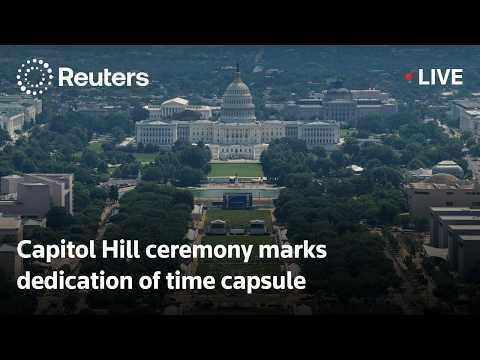
LIVE: Capitol Hill ceremony marks the dedication of time capsule
Congressional leaders gathered to dedicate a time capsule that will be sealed by the 119th Congress and opened in 2276 by the 244th Congress, containing artifacts from every state to commemorate America's 250th anniversary and convey current values to future generations.

What happens when the Federal Reserve goes quiet? | Econ World
New Federal Reserve Chair Kevin Walsh is spearheading a "silent revolution" by eliminating forward guidance and shortening statements to reduce market dependency on Fed signaling, sparking debate over whether less communication enhances or undermines central bank effectiveness during normal economic times.

LIVE: Outgoing British PM Keir Starmer takes questions in parliament
Outgoing Labour Prime Minister Keir Starmer defends his government's record on NHS investment, economic growth, and defense spending while facing sharp criticism from opposition leaders over his resignation and cabinet performance during his final parliamentary questioning session.

LIVE: US World Cup players speak from California base camp
US Men's National Team players highlight their tight-knit chemistry and competitive training culture as drivers of World Cup success, while discussing professional sacrifices, the importance of momentum, and the unique motivation of representing their home country on the West Coast.