Mark Rober's $60 Million Dollar Experiment
TL;DR
Mark Rober is investing $60 million and five years of his life to create Class Crunch Labs, a free, open-source STEM curriculum for grades 3-8 that applies YouTube-tested attention mechanics to science education. He details how bringing in former Discovery executive Scott Lurie as Chief Content Officer helped professionalize his operation without sacrificing the authentic creative vision that makes educational content actually stick.
🎓 The $60 Million Education Experiment 3 insights
Free curriculum funded by wealthy donors
Class Crunch Labs is a third-to-eighth-grade science curriculum costing $60 million to produce, funded entirely by donors and offered free forever to teachers with editable, customizable content.
Massive personal time commitment
Rober dedicates one week of every month for five years to this project, employing a 50-person team including 30 top science teachers to ensure it exceeds state standards.
Open-source educational model
The project invites competing curriculum companies to use their videos and methodology, aiming to move the entire science education space forward rather than capture market share.
🧲 The Attention-First Teaching Philosophy 3 insights
Hide the vegetables technique
The curriculum applies YouTube engagement tactics to classrooms, using spectacular demonstrations like crushing watermelons in MRI machines to earn attention before teaching scientific concepts.
Visceral response requirement
Rober emphasizes that content must trigger emotional reactions—amazement, shock, or curiosity—to achieve retention, whether distributed on YouTube, Netflix, or in schools.
Solving the motivation gap
Traditional science curricula fail because they don't earn student attention; this approach makes teachers the heroes while providing content sticky enough that students beg to rewatch it.
🏗️ Professionalizing Creator Operations 3 insights
From solo creator to structured business
Scott Lurie, former Discovery Channel executive, joined as Chief Content Officer to bring professional media operations to Rober's business after eight years of collaboration.
Financial and operational discipline
Lurie implemented systems that allowed the main YouTube channel to break even after losing seven figures annually, while enabling faster production workflows.
Preserving authenticity at scale
Unlike traditional Hollywood approaches that audiences reject as inauthentic, Lurie acts as an extension of Rober's creative vision, handling business rigor while maintaining the creator's distinctive voice.
Bottom Line
To achieve massive impact, creators must pair authentic storytelling with operational discipline, applying entertainment-first principles to educational content to overcome the motivation gap and actually earn audience attention.
More from Colin and Samir
View all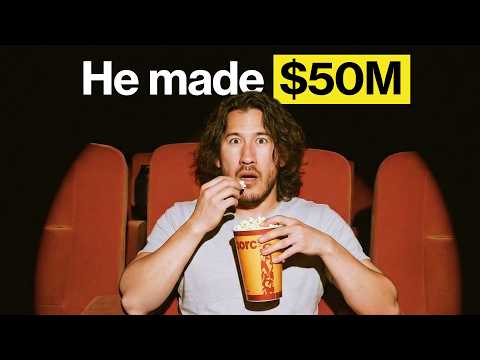
How Markiplier’s $50M Movie Changed Hollywood Forever
Markiplier's self-financed horror film 'Iron Lung' grossed $48 million on a $3 million budget without studio backing, demonstrating how a creator's deep community engagement and participatory content model can outperform traditional Hollywood distribution strategies.

The Internet Era Nobody Asked For
Colin and Samir analyze how AI-generated 'slop' and exponentially increasing content volume have created an 'abundance era' where supply drastically exceeds audience demand, threatening individual creators' ability to stand out while blurring the line between human and artificial content.

Why the Biggest YouTube Family Just Went to Netflix: Jordan Matter
Jordan Matter and his daughter Salish signed a rare three-year talent deal with Netflix granting them creative control over 3-4 shows, representing a strategic shift where streaming platforms prioritize intimate creator-audience relationships over traditional celebrity to capture younger demographics.
More in Podcasts
View all
Movement Practice to Strengthen Your Mind-Body Connection | Ido Portal
Ido Portal explains how to use discipline as temporary scaffolding rather than a crutch, while leveraging liminal sleep-wake states and micro-practices to achieve 24-hour awareness and rapid neuroplasticity.