LIVE: Treasury Secretary Bessent speaks at Economic Club of Dallas
TL;DR
Treasury Secretary Scott Bessent outlined the Trump administration's 'America First' economic security strategy built on three pillars—industrial dominance, domestic investment, and preparedness—while addressing a Supreme Court ruling that limits tariff revenue authority under IEEPA but preserves alternative paths via Sections 232, 301, and 122.
🏛️ The Three Pillars of Economic Security 3 insights
Economic security replaces efficiency as policy cornerstone
Bessent argued that past administrations prioritized 'faux efficiency' over resilience, contributing to the loss of 6 million manufacturing jobs between 1999-2011 and dangerous single-source supply chain dependencies.
Industrial and technological dominance prioritized
The administration is targeting critical vulnerabilities, noting that over 90% of advanced chips remain manufactured in Taiwan despite reshoring efforts, while AI infrastructure development is deemed crucial to both economic growth and national security.
Investment in America expands wealth participation
The 'Trump Accounts' initiative provides $1,000 Treasury-funded seed investments at birth to address the fact that nearly 40% of Americans lack equity market exposure, funded partly by a historic $6.25 billion donation from Michael and Susan Dell for 25 million children.
⚖️ Trade Policy and Tariff Strategy 3 insights
Supreme Court limits IEEPA tariff authority
The Court ruled 6-3 that the International Emergency Economic Powers Act cannot be used to raise tariff revenue, though Bessent emphasized the decision explicitly preserves presidential power to impose full embargoes and does not rule against tariffs generally.
Alternative tariff mechanisms ensure revenue continuity
Treasury will implement a 10% global tariff under Section 122 authority (limited to roughly 5 months) and launch new Section 232/301 investigations to replace IEEPA tariffs, ensuring 'virtually unchanged' revenue collection for 2026.
Existing collections face legal uncertainty
Approximately $175 billion in existing IEEPA tariff revenue faces potential refund claims after the Supreme Court remanded the issue to lower courts, though Bessent expects this to be 'dragged out for weeks, months, years.'
💵 Financial Innovation and Market Leadership 3 insights
Stablecoins reinforce dollar dominance
Bessent advocated for well-regulated dollar-based stablecoins to extend US currency network effects into digital payments, citing the GENIUS Act as providing Treasury with necessary oversight tools for transparency.
AI adoption optimized for growth
Treasury is shifting financial regulatory posture away from sole constraint toward encouraging responsible AI deployment, recognizing that failure to adopt productivity-enhancing technology is itself a risk to economic security.
Treasury market integrity underpins sovereignty
Preserving the strength, liquidity, and credibility of the Treasury market remains central to maintaining dollar reserve status, anchoring borrowing costs, and ensuring the effectiveness of sanctions.
🛡️ Geopolitical Preparedness 2 insights
Critical vulnerabilities in cyber and semiconductors
Bessent identified major cyber incidents disrupting financial infrastructure and Taiwan's concentration of advanced chip manufacturing as the two primary risk frontiers requiring immediate physical and digital safeguards.
Economic statecraft as deterrence
True preparedness requires ensuring no adversary believes it can hold the American economy hostage, integrating geopolitical risk as a primary factor across agency policymaking rather than an afterthought.
Bottom Line
The administration will maintain its tariff revenue and economic security agenda by shifting legal authority from IEEPA to Sections 232, 301, and 122, ensuring that reshoring critical production and technological dominance remain policy priorities regardless of court rulings.
More from Reuters
View all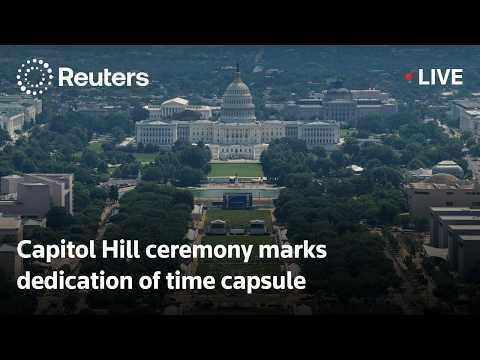
LIVE: Capitol Hill ceremony marks the dedication of time capsule
Congressional leaders gathered to dedicate a time capsule that will be sealed by the 119th Congress and opened in 2276 by the 244th Congress, containing artifacts from every state to commemorate America's 250th anniversary and convey current values to future generations.

What happens when the Federal Reserve goes quiet? | Econ World
New Federal Reserve Chair Kevin Walsh is spearheading a "silent revolution" by eliminating forward guidance and shortening statements to reduce market dependency on Fed signaling, sparking debate over whether less communication enhances or undermines central bank effectiveness during normal economic times.

LIVE: Outgoing British PM Keir Starmer takes questions in parliament
Outgoing Labour Prime Minister Keir Starmer defends his government's record on NHS investment, economic growth, and defense spending while facing sharp criticism from opposition leaders over his resignation and cabinet performance during his final parliamentary questioning session.

LIVE: US World Cup players speak from California base camp
US Men's National Team players highlight their tight-knit chemistry and competitive training culture as drivers of World Cup success, while discussing professional sacrifices, the importance of momentum, and the unique motivation of representing their home country on the West Coast.