LIVE: Japanese cargo craft departs International Space Station
TL;DR
Japan's HTV-X1 cargo spacecraft successfully departed the International Space Station after a 4.5-month cargo mission, beginning a 99-day free-flying scientific operations phase before its eventual controlled de-orbit over the Pacific Ocean.
🚀 Departure Execution 3 insights
Precision timing over Pacific Ocean
HTV-X1 was released from the Canadarm2 robotic arm at exactly 11:00 a.m. Central Time (noon Eastern) as the International Space Station flew 260 miles over the central Pacific Ocean.
Successful robotic release sequence
Ground controllers in Houston commanded the Canadarm2 to open its snares and back away after confirming the spacecraft was stable and all systems were nominal.
Engine burn establishes safe trajectory
The spacecraft executed a 36.5-second departure burn to increase its opening rate by 0.45 meters per second, successfully exiting the station's keepout sphere and approach ellipsoid boundaries.
🔬 Scientific Mission Extension 2 insights
99-day free-flying laboratory phase
HTV-X1 will now spend approximately three months operating as a scientific platform above and behind the station, supporting JAXA experiments before its scheduled de-orbit and burn-up over the Pacific.
Cargo delivery mission complete
The spacecraft successfully completed its 4.5-month cargo delivery mission after being grappled on October 29th and berthed to the Harmony module's Earth-facing port.
🛰️ Operational Significance 3 insights
Maiden voyage of next-generation vehicle
This mission marked the inaugural flight of JAXA's new HTV-X generation cargo craft, designed to support future exploration activities beyond low Earth orbit.
International mission control coordination
The departure required synchronized operations between NASA's Mission Control Houston and JAXA's flight control room in Tsukuba, Japan, monitored by JAXA astronaut Aki Hoshide from Houston.
Precedent for upcoming Cygnus departure
The procedure mirrored the upcoming departure of Northrop Grumman's Cygnus NG-23 (SS Willie McCool) scheduled for the following Thursday, March 12th.
Bottom Line
The successful departure demonstrates the dual-use
More from Reuters
View all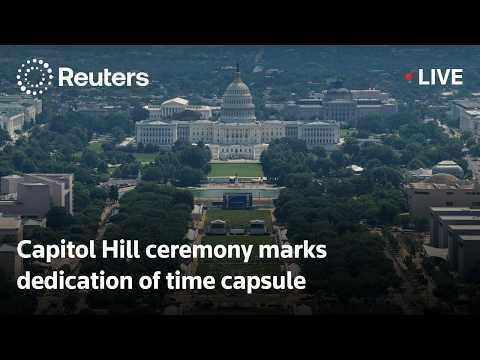
LIVE: Capitol Hill ceremony marks the dedication of time capsule
Congressional leaders gathered to dedicate a time capsule that will be sealed by the 119th Congress and opened in 2276 by the 244th Congress, containing artifacts from every state to commemorate America's 250th anniversary and convey current values to future generations.

What happens when the Federal Reserve goes quiet? | Econ World
New Federal Reserve Chair Kevin Walsh is spearheading a "silent revolution" by eliminating forward guidance and shortening statements to reduce market dependency on Fed signaling, sparking debate over whether less communication enhances or undermines central bank effectiveness during normal economic times.

LIVE: Outgoing British PM Keir Starmer takes questions in parliament
Outgoing Labour Prime Minister Keir Starmer defends his government's record on NHS investment, economic growth, and defense spending while facing sharp criticism from opposition leaders over his resignation and cabinet performance during his final parliamentary questioning session.

LIVE: US World Cup players speak from California base camp
US Men's National Team players highlight their tight-knit chemistry and competitive training culture as drivers of World Cup success, while discussing professional sacrifices, the importance of momentum, and the unique motivation of representing their home country on the West Coast.