LIVE: European Parliament debates US tariffs
TL;DR
EU Trade Commissioner Maroš Šefčovič defended the bloc's trade strategy amid shifting global dynamics, addressing a recent US Supreme Court ruling on presidential tariff powers, China's €360 billion trade surplus with Europe, and progress on diversifying through agreements with Mercosur, India, and Indonesia, while MEPs criticized the asymmetrical EU-US deal and urged faster liberalization.
🇺🇸 US Trade Relations & Tariff Turmoil 3 insights
Supreme Court limits presidential tariff authority
The US Supreme Court ruled that the President cannot impose tariffs under the International Emergency Economic Powers Act (IEEPA), prompting President Trump to enact a temporary 10% baseline import charge until July 24 while maintaining exemptions for aircraft, pharmaceuticals, and energy.
Section 232 tariffs remain untouched
The court ruling did not affect existing Section 232 tariffs on cars, steel, and aluminum, which continue to create transatlantic friction despite US Trade Representative Jameson Greer's public reassurance that Washington stands by the July 2024 joint statement deal.
MEPs challenge asymmetrical agreement terms
Parliament members criticized the EU-US deal that lowered European tariffs to 0% while the US retained 15%, arguing that the new 10% baseline eliminates Europe's preferential advantage and creates a level playing field that undermines the original compromise.
🇨🇳 China's Economic Dominance & EU Response 3 insights
Manufacturing output rivals EU and US combined
China's manufacturing reportedly equals the combined output of the EU and US, commanding 30% of global share with growing dominance in higher-value supply chains and key industrial sectors.
Record €360 billion trade deficit
The EU's bilateral trade deficit with China reached €360 billion in 2025, accompanied by declining market access for European companies and the displacement of EU exports in third countries by subsidized Chinese competitors.
Three-pillar security strategy
The EU is pursuing a three-fold response of diplomatic engagement with Beijing, autonomous trade and industrial action under the Economic Security Strategy, and accelerated diversification through new free trade agreements with like-minded partners.
🌐 Diversification Through New Trade Agreements 3 insights
Mercosur delay cost €183 billion in exports
The delayed EU-Mercosur agreement cost Europe an estimated €183 billion in exports and €291 billion in GDP between 2021-2025, blocking access to a regional market of over 700 million people and creating urgency for provisional application.
India FTA unlocks high-tariff economy
The recently agreed free trade agreement with India will liberalize 97% of bilateral trade, with 90% of tariffs reaching zero and generating €4 billion in annual tariff savings for EU exporters.
Indo-Pacific expansion accelerates
Negotiations are advancing with Indonesia (98% trade liberalization), Australia, the Philippines, Thailand, Malaysia, and the UAE, alongside efforts to forge closer relations with the CPTPP and pursue digital trade agreements.
🛡️ Economic Security & Legislative Agenda 3 insights
Paradigm shift to proactive security posture
The December Economic Security Strategy requires EU institutions and industry to systematically factor in a 'security premium' to reduce vulnerabilities, moving from reactive measures to targeted use of trade defense tools.
Steel safeguards tighten import controls
Proposed steel measures include reducing import quotas by 47%, doubling out-of-quota duties to 50%, and introducing strengthened traceability requirements via 'melted and poured' origin standards to prevent circumvention.
FDI screening and GSP framework concluded
Parliament advanced the Foreign Direct Investment screening regulation for investment scrutiny and finalized the new Generalized Scheme of Preferences (GSP) framework governing trade relations with 65 developing countries.
Bottom Line
The EU must urgently ratify pending trade agreements like Mercosur and recalibrate its US strategy to account for the eliminated tariff advantage, while deploying economic security tools to reduce critical dependencies on China.
More from Reuters
View all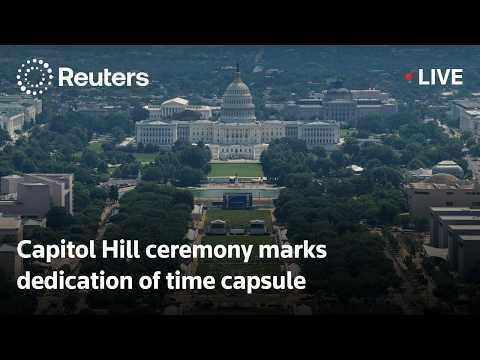
LIVE: Capitol Hill ceremony marks the dedication of time capsule
Congressional leaders gathered to dedicate a time capsule that will be sealed by the 119th Congress and opened in 2276 by the 244th Congress, containing artifacts from every state to commemorate America's 250th anniversary and convey current values to future generations.

What happens when the Federal Reserve goes quiet? | Econ World
New Federal Reserve Chair Kevin Walsh is spearheading a "silent revolution" by eliminating forward guidance and shortening statements to reduce market dependency on Fed signaling, sparking debate over whether less communication enhances or undermines central bank effectiveness during normal economic times.

LIVE: Outgoing British PM Keir Starmer takes questions in parliament
Outgoing Labour Prime Minister Keir Starmer defends his government's record on NHS investment, economic growth, and defense spending while facing sharp criticism from opposition leaders over his resignation and cabinet performance during his final parliamentary questioning session.

LIVE: US World Cup players speak from California base camp
US Men's National Team players highlight their tight-knit chemistry and competitive training culture as drivers of World Cup success, while discussing professional sacrifices, the importance of momentum, and the unique motivation of representing their home country on the West Coast.