LIVE: Europe's Ariane 64 launches 32 Amazon Leo satellites into orbit
TL;DR
Europe's Ariane 64 rocket debuted its heavy-lift configuration carrying 32 Amazon Leo satellites, marking the first of 18 launches to deploy a 3,000-satellite constellation aimed at delivering high-speed broadband to underserved global communities.
🚀 Ariane 64 Technical Milestones 3 insights
Ariane 64 debuts four-booster heavy-lift configuration
The rocket flies for the first time with four solid boosters and a 20-meter long payload fairing, distinguishing it from the lighter Ariane 62 variant and enabling heavier payloads.
Controlled Pacific reentry eliminates orbital debris risk
The upper stage will perform a final burn and passivation before intentional reentry over the Pacific Ocean to avoid leaving rocket debris orbiting Earth.
Multi-burn deployment sequence over three continents
Following liftoff and booster separation at 2 minutes 25 seconds, the Vinci engine executes three separate burns to deploy satellites over a 25-minute sequence spanning Europe, India, and Australia.
🛰️ Amazon Leo Constellation Architecture 3 insights
Initial deployment of 3,000-satellite broadband network
This launch carries 32 satellites for Amazon's Project Kuiper, designed to connect nearly 3 billion people without high-speed internet through low Earth orbit coverage at 590-630 km altitude.
Low Earth Orbit delivers terrestrial-grade broadband speeds
The LEO positioning eliminates the latency of geostationary satellites, enabling real-time applications like video conferencing with speeds comparable to fiber internet.
Revolutionary single-aperture customer terminals
Amazon engineered breakthrough antennas combining transmit and receive functions into one aperture, delivering up to 400 Mbps for residential units and 1 Gbps download for enterprise terminals.
💼 Economic & Strategic Impact 3 insights
Record contract contributes €0.8 billion to European GDP
The program supports thousands of suppliers and skilled jobs across Europe, from Italian booster production to Swedish dispenser systems, generating substantial economic value continent-wide.
Amazon commits to 18 heavy-lift launches with Arianespace
As Arianespace's largest commercial customer, Amazon secured a record-breaking series of 18 heavy-lift launches to complete its constellation deployment over the coming years.
Vertical integration enables rapid satellite production
Amazon operates a dedicated payload processing facility with capacity to integrate up to five satellites per day and run three simultaneous launch campaigns.
Bottom Line
This launch establishes Europe as a critical infrastructure provider for commercial mega-constellations while simultaneously kickstarting Amazon's global broadband network through a multi-billion euro strategic partnership.
More from Reuters
View all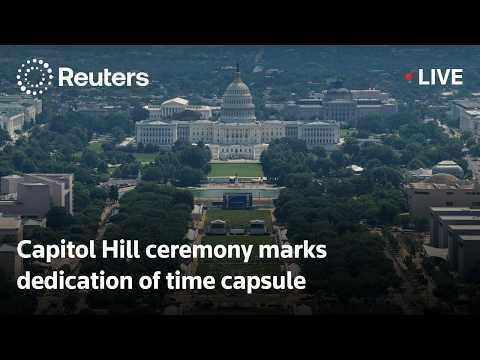
LIVE: Capitol Hill ceremony marks the dedication of time capsule
Congressional leaders gathered to dedicate a time capsule that will be sealed by the 119th Congress and opened in 2276 by the 244th Congress, containing artifacts from every state to commemorate America's 250th anniversary and convey current values to future generations.

What happens when the Federal Reserve goes quiet? | Econ World
New Federal Reserve Chair Kevin Walsh is spearheading a "silent revolution" by eliminating forward guidance and shortening statements to reduce market dependency on Fed signaling, sparking debate over whether less communication enhances or undermines central bank effectiveness during normal economic times.

LIVE: Outgoing British PM Keir Starmer takes questions in parliament
Outgoing Labour Prime Minister Keir Starmer defends his government's record on NHS investment, economic growth, and defense spending while facing sharp criticism from opposition leaders over his resignation and cabinet performance during his final parliamentary questioning session.

LIVE: US World Cup players speak from California base camp
US Men's National Team players highlight their tight-knit chemistry and competitive training culture as drivers of World Cup success, while discussing professional sacrifices, the importance of momentum, and the unique motivation of representing their home country on the West Coast.