Google I/O 2026 keynote in 35 minutes
TL;DR
Google I/O 2026 unveiled a comprehensive shift from reactive AI to autonomous agentic systems, introducing Anti-Gravity 2.0, the persistent Gemini Spark agent, and Gemini 3.5 Flash alongside multimodal creation tools and a redesigned search infrastructure that promises to handle complex tasks continuously in the background.
🤖 Autonomous Agents & Anti-Gravity 4 insights
Anti-Gravity 2.0 Desktop Launch
A new standalone desktop application featuring sub-agents, hooks, and asynchronous task management that enables Gemini to build complex projects like operating systems from scratch.
Gemini Spark 24/7 Agents
Personal AI agents running on dedicated Google Cloud VMs that perform long-running background tasks via voice, email, or chat, integrating with third-party tools through MCP.
Persistent Search Agents
Background monitoring agents that continuously scan the web across sites, social media, and forums for specific criteria like apartment listings or product drops, delivering proactive updates.
Daily Brief Agent
An out-of-the-box agent that synthesizes inbox, calendar, and task data into a concise morning digest organized by topic with suggested next actions.
🧠 New Models & Creative Workflows 4 insights
Gemini 3.5 Flash Speed
A frontier-intelligence model co-optimized with Anti-Gravity that delivers outputs 4x faster than competitors while outperforming 3.1 Pro on coding and economically valuable benchmarks.
Gemini Omni Video Generation
A multimodal model combining video, image, and simulation capabilities with intuitive physics understanding, enabling conversational video editing from any input including user selfies.
Voice-First Productivity Tools
Docs Live enables real-time voice-controlled document creation and editing in Workspace, while Ask YouTube offers conversational search that jumps directly to relevant video segments.
Generative UI in Search
Search now dynamically builds custom interactive visualizations and widgets on demand using Anti-Gravity coding, creating tailored educational interfaces for complex queries like astrophysics.
🔍 Search Evolution & Trust 4 insights
Universal Cart Intelligence
A cross-merchant shopping cart that works across Search, YouTube, and Gmail to track price drops, monitor stock, and find deals automatically in the background.
Multimodal Search Box Redesign
The first major upgrade to Search in 25 years supports text, image, file, and video inputs while unifying AI overviews and AI mode into a seamless conversational experience.
Content Credentials Expansion
Synth ID verification expands to Search and Chrome with new partnerships from OpenAI, Cacao, and Leven Labs, enabling users to verify AI-generated content origins and edits.
Neural Expressive Design
A complete Gemini app redesign featuring fluid animations, vibrant colors, and regional dialect options for Gemini Live, rolling out globally across Android, iOS, and web.
Bottom Line
Google is transitioning from passive AI assistance to autonomous agents that perform complex, multi-step tasks continuously in the background, requiring users to adapt to a new paradigm of delegated digital labor and persistent AI access.
More from The Verge
View all
The video game disc is dead | The Vergecast
Sony announced it will stop manufacturing PlayStation discs by 2028 while Microsoft tests disc-to-digital conversion, signaling the end of physical game media amid collapsing console sales, major Xbox layoffs, and the failure of the industry's live-service gamble.

Rivian’s last chance to take on Tesla | The Vergecast
Rivian stands at a critical crossroads with the launch of its R2 SUV, attempting to transition from a luxury niche to mainstream success amid the elimination of federal EV tax credits, rising gas prices, and the urgent need to prove it can scale production while maintaining quality.

Meet The Onion's new and improved InfoWars | The Vergecast
The Onion is relaunching InfoWars on July 2nd as a satirical streaming platform after acquiring it through bankruptcy auction, with comedian Tim Heidecker serving as creative director to transform the conspiracy site into an expanded comedy network.
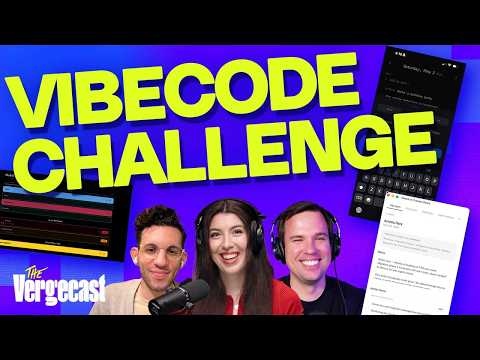
Our vibe coded projects that actually work | The Vergecast
The Vergecast hosts embark on a vibe coding challenge to build personal software using AI, discovering that identifying genuinely useful daily problems is harder than solving them, with the most successful projects being hyper-specific tools rather than ambitious feature-packed applications.